
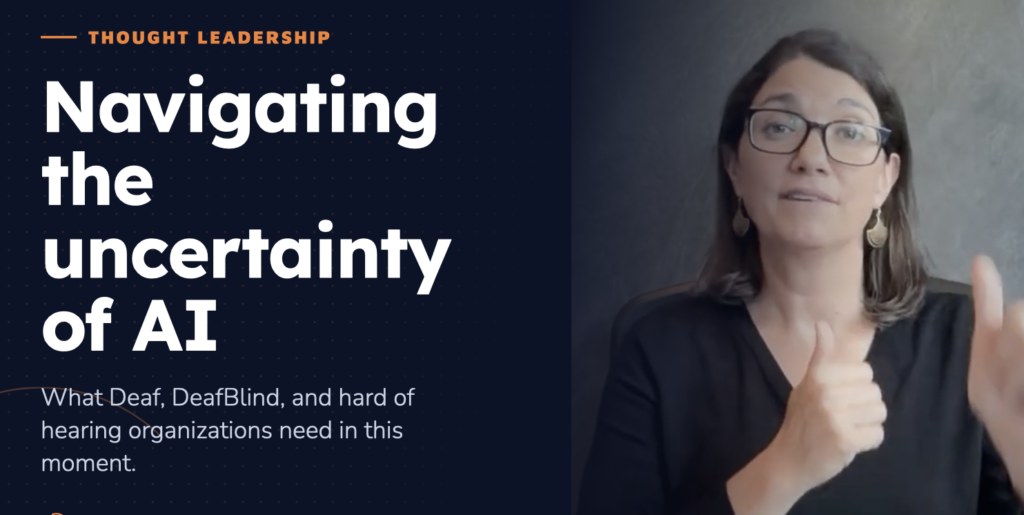
What Deaf, DeafBlind, and Hard of Hearing Organizations Need — and What Innivee Strategies Brings to This Moment
THE MOMENT
Twenty-five years ago, transformative technologies – automated captioning, Video Remote interpreting – arrived in our communities without the Deaf and Hard of Hearing community at the table. We did not lead those conversations. We did not shape those decisions. The result: tools were deployed for us, without us. Standards that came too late and we are still addressing these harms today.
Today, AI is following a similar path, but also different — much more powerful, much more transformative. We now understand what we could have done, should have done, and can do with this moment.
AI will reshape how Deaf, DeafBlind, and hard of hearing people communicate, work, interact, and move through the world. The only real question is this: Will we shape that change, or will we manage its consequences? Will we move proactively to maximize the genuine benefits AI can bring to our communities while also predicting and mitigating the risks — or will we repeat the patterns of the past?
This is not a moment to manage technology. It is a moment to own it. And it requires organizations to show up differently than we did before.
HOW INNIVEE STRATEGIES APPROACHES THE HARD QUESTIONS
The questions AI raises are not simply technical or strategic — they are adaptive, requiring organizations to examine their values, relationships, and leadership in a rapidly shifting landscape. AI cannot do these things. Our approach brings four interlocking lenses to every engagement.
1. We ask questions that prompt introspection, strategic thinking, and deeper self-reflection — not to provide easy answers, but to help organizations figure out their own answer – best path, best fit, best investments of time, resources and money. Before engaging with AI, the real question is: Do we have clarity in our goals? Have we determined what terms we should be setting? What decisions are actually in play, and what’s already decided? Where do we have genuine leverage to shape outcomes that matter to our community? Does your organization have a strategic posture — not just a policy — that lets you engage from a position of strength rather than acceptance? These are the questions that let you move proactively, on your own terms.
2. We focus on innovative and creative thinking – creating opportunities, fostering momentum, and creating change — rather than leading with challenges or gaps. The AI landscape is not only something to manage; it is a moment of leverage. The community’s language, relationships, and lived knowledge are genuine assets and recognizing that is essential to getting this right. Organizations that see this clearly can set their own terms, shape policy before it is set, and build the internal capacity to remain relevant and powerful in the years ahead.
3. We support organizations in thinking transformatively, pivoting quickly, taking on smart risks, and remaining disciplined in assessment. AI is fundamentally an adaptive challenge — not a technical one. There are no plug-and-play solutions. The VRI precedent shows what happens where there is fast deployment, delayed accountability, lasting harm. Organizations need the internal literacy and high level governance structures to address these challenges and keep the community’s values at the center of decisions, where it belongs. That capacity is what leads proactively rather than reacts to what others have decided.
4. We approach every engagement so that clients and their communities have genuine ownership of co-creating solutions — not receiving them from outside. On AI, that means helping organizations develop their own framework that works best for them: facilitating the internal conversations that need to happen before engaging with AI in order to create clarity, to ensure the people most affected by data decisions are also involved in making them. The capacity your organization builds stays with your organization.
Engaging AI responsibly means asking not only what is possible and what is right — but developing the framework to act on the answers.
WHERE INNIVEE STRATEGIES STANDS
Innivee Strategies has been having these conversations about AI since the beginning. We have facilitated Deaf Leadership & Sign Language AI and Integrating AI into Deaf Organizations workshops at the World Federation of the Deaf Conference, engaging organizational leaders from across the globe. We have been involved with CoSET and its #DeafSafeAI framework since inception — contributing to the principles now shaping community governance of sign language AI. We have led and supported organizations serving state, national and international Deaf communities, as well as the world’s largest organization of interpreters. We are engaged with the entities that govern AI in communication access and accessibility. This work is happening now.
Innivee Strategies uses AI in our own daily operations. We know where it helps, where it fails, and how to tell the difference between hype and utility. We bring that same discipline to every organization we serve.
WHAT WE BRING TO ORGANIZATIONS IN THIS MOMENT
AI governance is new territory for every sector. What matters is not a polished AI practice — it is the capacity to think clearly, ask the right questions, and bring deep community knowledge to decisions that are moving fast and have lasting consequences.
- Develop internal AI policies for organizations — the foundational step that most organizations have not yet taken
- Building AI literacy across leadership — so organizations and executives can ask the right questions and make informed decisions
- Thinking through how to use AI in operations — strategically, ethically, and in ways that strengthen rather than compromises the mission
- Connecting organizational strategy to the emerging governance and policy landscape — because what gets decided at the federal and international level will shape what is possible at the organizational level
- Using AI to map the national landscape, identify models for success within our community, and translate them to your organization’s context
The question is not whether organizations can afford to take AI seriously. It is whether it can afford not to. We are here to help organizations lead through this rapidly changing landscape .